Texts of Nashe’s Have with you to Saffron-walden (1596) are posted here:
Modern spelling: www.oxford-shakespeare.com/Nashe/Have_With_You_To_Saffron_Walden.pdf
Original spelling: https://quod.lib.umich.edu/e/eebo/A08003.0001.001?view=toc
Does the Writing Style of Saffron-Walden Prove Thomas Nashe Existed?
An Oxfordian using the pseudonym “Ned Devere” posts commentary online. (As to the identity of this person who has lain her pearls before us, I lean toward a certain Johnnie-come-lately. But I digress.)
“Ned” has done the world a fine service by annotating Arthur Golding’s Ovids Metamorphoses (1565/7) and Thomas Nashe’s Have with you to Saffron-walden (1596).* Flipping back and forth between the text and notes is cumbersome, but the books are scholarly and useful treatments.
Unfortunately, with an air of pompous derision — from which I will spare you and to which I will refrain from responding in kind — Ned also wrote an online post dismissing the “meme” that Thomas Nashe is a pen name of the Earl of Oxford.
Ned readily accepts the idea that Arthur Golding is a pen name of the Earl of Oxford but flatly rejects the notion that Thomas Nashe is one as well. He seems unaware that modern-day reviewers of Golding’s Metamorphoses and Nashe’s Lenten Stuffe use almost precisely the same terminology to describe the prose style utilized in both volumes. (Details are supplied in Critique Reply #3 and in the Thomas Nashe chapter of Oxford’s Voices.)
Ned cites as a fellow critic of my thesis a person who thinks that Christopher Marlowe wrote the Shakespeare canon. In my view, anyone who cannot tell the difference between the writing styles of Shakespeare and Marlowe (see “Distinguishing Marlowe from Shakespeare” within Oxford’s Voices) lacks the expertise to tell Oxford’s pen names from independent writers.
Ned offers no study differentiating Nashe’s writing from Shakespeare’s, just a blanket opinion. Posing as the Earl of Oxford, he has our hero say this:
As with everything Tom wrote in his short life, in Saffron Walden he is his own man from cover to cover. …I was no Tom Nashe. …He was sui generis, a unique voice in English letters.**
Our critic, then, holds up Nashe’s Have with you to Saffron-walden as proof positive that Nashe’s writing is unique and as dissimilar from Oxford’s as unicorns are from roofing nails. So, we have a challenge. Can we show we are right by Ned’s own case in point?
We can. Right off the bat, the opening text of Nashe’s pamphlet contains a heap of impressive linguistic parallels to Shakespeare. They are rendered below in modern spelling for easy comparison:
Dedication
prolixious…barbarism: “prolixious blushes” in Measure for Measure (II, iv); barbarism is in Shakespeare 4 times
thrice-egregious: Shakespeare uses this “thrice-” construction 17 times. Nashe’s phrase is a humorous inversion of “thrice-gorgeous” from Henry V (IV, i)
vagrant mustachios: “mad mustachio” in Henry IV Part 1 (II, i)
excremental superfluities (referring to hair or beard): Shakespeare uses excrement four times to refer to hair or a beard, and superfluity four times, including in reference to hair: “superfluity comes sooner by white hairs” in The Merchant of Venice (I, ii)
notable and singular benefactor: “notable coward” in All’s Well (III, vi); “men/ Of singular integrity” in Henry VIII (II, iv); “great benefactors” in Timon of Athens (III, vi); notable is in Shakespeare 14 times, singular 8 times, benefactor 4 times; the construction is a hendiadys, one of Shakespeare’s favorite rhetorical devices.
beards in general: “the horses…In general” in Henry IV Part 1 (IV, iii)
First Paragraph
Acute and amiable: “meet or amiable” in The Taming of the Shrew (V, ii)
red herrings: “white herring” in King Lear (III, vi), “a cade of herrings” in Henry VI Part 2 (IV, ii)
Dick of all Dicks: “Th’observ’d of all observers” in Hamlet (III, i)
Desperate Dick: “desperate creature” in All’s Well (V, iii); “desperate men” in King John (III, i)
chine of beef: “chines of beef” in Edward III (III, iii); and among three other Voices
half a dozen brewers’ draymen: “A brace of draymen” in Richard II (I, iv)
demi-lance: Shakespeare uses “demi-” ten times
who played his prizes…so bravely: “you have play’d your prize” in Timon of Athens (I, i); “so bravely won” in Cymbeline (II, iv)
gallant…as good a fellow: “Goodly and gallant…fellow” in Cymbeline (III, iv)
courteous Dick, comical Dick, lively Dick, lovely Dick, learned Dick: All five adjectives appear in Shakespeare, four of which are paired with a proper name: “courteous Antony,” “lively Helena,” “lovely Edward” and “learned Theban.”
Next Sentence
“thou wonderest not a little”: “thou wonder” in Venus and Adonis; “not a little” in Henry VIII (V, iii)
“to come upon thee so strangely”: “That we meet here so strangely” in Cymbeline (V, v)
“in a heap altogether”: “all on a heap” in Titus Andronicus (II, iii); here Nashe uses “altogether” to mean “together,” as Sir Andrew does in Twelfth Night (I, iii): “I delight in masques and revels sometimes altogether.”
“thy honorable family…thy name”: “Thy name and honorable family” in Titus Andronicus (I, i)
“affluent and copious”: another hendiadys; “copious” is in Shakespeare twice.
“in all places”: “in all places” in The Taming of the Shrew (I, i)
Finding these parallel constructions did not require cherry-picking of any sort. Nor are they scattered far apart within the text. From the start of Nashe’s pamphlet, they emerge in a flood.
You will not find examples of Shakespeare’s distinctive verbiage — prolixious, mustachio, excrement (for hair), draymen, superfluity of hairs, chine of beef, play’d your prize, meet here so strangely — sprinkled throughout works by independent writers. Nashe’s brief text features additional colorful terms: reverent, supervisor, felicity, musing, devours, hewing, pike, buckler and swash, all of which likewise appear in Shakespeare.
All these shared words and expressions appear on the equivalent of one page of Nashe, as highlighted in the image below. Imagine how long this list would become if we were to go through Nashe’s lengthy pamphlet, as Ned bids us, “from cover to cover”!
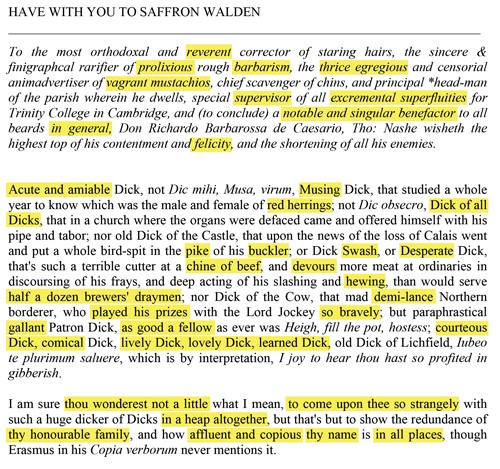
Let’s calculate. In the notes within his book on Saffron-walden, Ned ties but one word (prolixious) to Shakespeare in the entire above-analyzed text. If one can generalize from that paucity, Ned is missing 30 links for each one ascertained. Because he connects a total of 60 terms and phrases to Shakespeare in the entire pamphlet, there should be 1860 of them. That estimate is probably low. The text mined above takes up 3/5 of a page in Nina Green’s modern-spelling version of Saffron-walden, which covers 78.6 pages. 31 terms x 78.6 pages x 5/3 = 4061 terms. So, there are probably somewhere between 2000 and 4000 linguistic echoes of Shakespeare in Thomas Nashe’s Saffron-walden. These links are distinctive, too, not tallies of how many times a writer uses and or ye, such as we find in Stratfordians’ stylometric studies.
As for notable instances in later pages of the pamphlet, J.J.M. Tobin was astonished to find vivid expressions within Saffron-walden that were, like many of those cited above, “each unique to the Shakespearean canon.”*** In other words, they are shared only by Shakespeare and Nashe within the entirety of Elizabethan literature. One of his examples is from Justice Shallow in Henry IV Part 2 (III, ii), who talks of “the Inns o’ Court” where
“we knew where the bonarobas were” and of being “at the court gate” near where “I did fight with one Samson Stockfish, a fruiterer, behind Gray’s Inn.”
In Saffron-walden, Nashe describes Harvey’s pamphlet as big as
“a stack of salt-fish” and a “fulsome a fat Bonarobe” requiring a “hoope it about like the tree at Gray’s Inne gate.”
Biographers habitually contend that Nashe might have known such information, but we can flatly state that Oxford would have known it because he attended Gray’s Inn. He would have observed the belted tree near the gate, the location of the food cart, and where the local talent (bona-robas) hung out.
Another confirmation of Oxford’s authorship of Saffron-walden is that it shares a distinctive, if not unique, characteristic with Shakespeare: the vivid, energetic put-down. Ned celebrates Nashe’s flamboyant name-calling as if it is unique in Elizabethan literature. Yet whole books have been titled Shakespeare’s Insults or variations thereof.
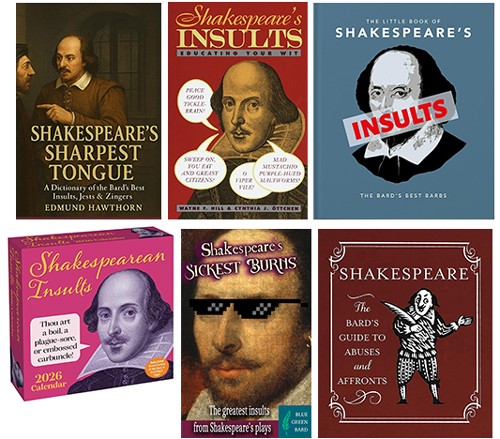
Shakespeare is an inveterate name-caller, and so is Nashe. Among independent writers of the era, none draw from a comparable quiver of invectives. Gabriel Harvey musters epithets, but they aren’t as amusing as Oxford’s. Ben Jonson disparages many people and characters, but his cuts are not as self-consciously extravagant as those invented by Oxford’s Voices.
The insults Oxford employs via his pen names are not carbon copies of each other because he rarely repeats himself, but they are of the same linguistic ilk. In Saffron-walden, Nashe calls Harvey “tame-witted…Gabriel Scurvie…an ass.” How can one not hear Thersites in Shakespeare’s Troilus and Cressida (II, i) call Ajax a “beef-witted lord” and a “scurvy-valiant ass”? Shakespeare pairs pride with ambitious/ambition nine times, and Nashe berates Harvey for his “ambitious pride.” Nashe’s “Domine Deuce-ace” sounds unique, but both “domine” (IV, ii and V, i) and “deuce-ace” (I, ii) are in Love’s Labour’s Lost. Nashe and Shakespeare use the same terms and forms in crafting their imaginative insults.
Even the title page of Saffron-walden holds a clue about authorship. Robert Greene had placed the motto, Omne tulit punctum, on eleven of his books. As if he were Greene (which he is), Nashe states on the title page, “The Mott or Posie, instead of Omne tulit punctum: Pacis fiducia nunquam.” [never trust peace] Oxford had his Nashe pen name pick up where his Greene pen name left off, and their singular identity slips out even here.
I may be virtually alone in concluding that Nashe is a pen name of Oxford’s, but I have distinguished company in countering Ned’s assertion, “Nashe is his own man from cover to cover.” Scholars James Tobin, J. Dover Wilson and Penny McCarthy have all expressed dismay over the extent to which linguistically — and even ideationally and emotionally — Nashe is Shakespeare, and Shakespeare is Nashe.
Critics keep making the same mistake based on their subjective “feel” of literary material. To Stratfordians, Shakespeare feels like a Warwickshire lad, but he is nothing of the kind — if you look. Robert Greene has a fire-and-brimstone passage in The Repentance that sounds nothing like Shakespeare — until you look. (Search on “I know not whether God” in Oxford’s Voices.) Thomas Nashe produces dense and whimsical passages that sound nothing like Shakespeare — until you look.
Why, then, are critics so certain of their opinions? Why do they feel justified in expressing smug reactions without bothering to read my case?
I think their feelings stem from Oxford’s thorough success at creating a lively, entertaining persona: the witty, brazen, poverty-stricken curmudgeon, Tom Nashe. Oxford’s contemporaries knew what was going on, but Oxford has Nashe’s modern fans fooled.
Ned says above that all Nashe’s works evidence his linguistic uniqueness. That is not so. One can perform the same deep dive on all of them, and one will come up with the same result: a dense overlap of shared linguistic tricks throughout all works in the canons of Nashe and Shakespeare.
The numerous and striking verbal parallels we uncovered in such a brief text explain why Dover Wilson threw up his hands and “could not account for them.”**** The idea that one person is behind both pen names does account for them, neatly and simply.
Nashe is not his own man; he is Oxford’s man.
* “Ned Devere,” Metamorphoses, Good Name Press, Tyrone PA, 2024; Saffron Walden Annotated, Good Name Press, Tyrone PA, 2024; revised 2025
** “Ned Vere,” “Shakespeare Yes, Thomas Nashe No,” Shake-Speare’s blog, edevere17.com, June 22, 2025
*** Tobin, J.J.M., “Texture as Well as Structure: More Sources from The Riverside Shakespeare,” In the Company of Shakespeare—Essays on English Renaissance Literature, Moisan, Thomas, and Douglas Bruster, Eds., Associated University Presses, Cranbury, NJ, 2002, p.102
**** McCarthy, Penny, Pseudonymous Shakespeare, Ashgate Publishing Ltd., Burlington VT, 2006, p.146